
Dennis J. Paustenbach, TRC Companies Inc. / Paustenbach & Associates, Jackson, Wyoming, US
Blake Langenbach, TRC Companies Inc. / Paustenbach & Associates, Boulder, Colorado, US
Richard J. Wenning – Wenning Environmental LLC, Yarmouth, Maine, US
Chapter 1, Primer on Human and Environmental Risk Assessment. In: Human and Ecological Risk Assessment -Theory and Practice Third Edition, Volume 2; D.J. Paustenbach (ed.). https://doi.org/10.1002/9781119742975.ch1
ABSTRACT:
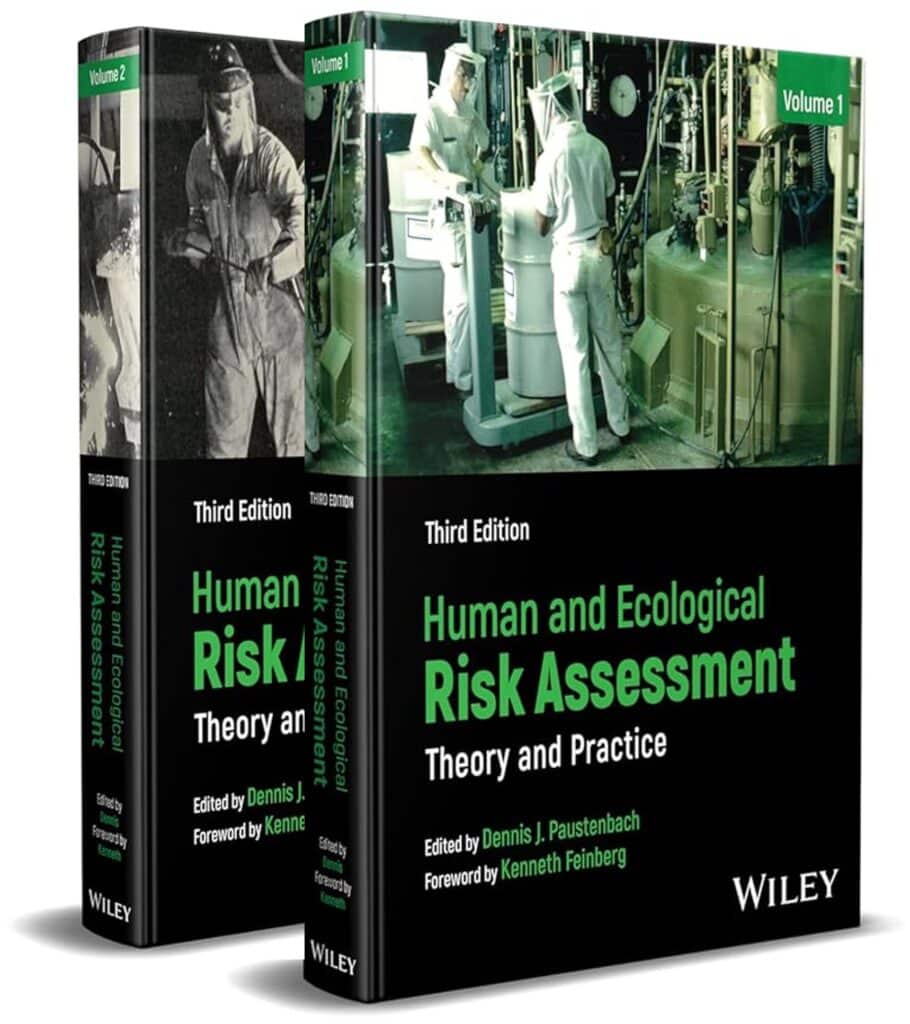
Modern risk assessment evolved from mid-20th century advances in human exposure and toxicology and was formally structured by the U.S. National Academy of Sciences (1983) into a four-step framework that supports environmental regulation, chemical management, and public health decision-making worldwide. The third edition of Dennis J. Paustenbach’s seminal textbook, Human and Ecological Risk Assessment, Theory and Practice, Volumes 1 & 2 (2024, Wiley), covers the fields of chemical fate and transport, ecotoxicology, environmental and exposure science, epidemiology, human toxicology, modeling, pharmacokinetics, and related disciplines that shape modern health and ecological risk assessment practices.
This chapter, “Primer on Human and Environmental Risk Assessment,” provides an overview of the scientific foundations, development, and practical importance of risk assessment in evaluating the potential harmful effects of chemical and physical hazards on humans and ecosystems. It clarifies the key differences among hazard, toxicity, and risk, highlighting that risk depends not only on a substance’s inherent qualities but also on the level, duration, and vulnerability of exposure. The chapter stresses how risk assessment has become a vital tool for organizing scientific data to support environmental policy, public health protection, and regulatory decisions, while also acknowledging ongoing tensions between scientific evidence, public perception, and policy considerations.
The chapter also describes the standard four-step risk assessment framework established by the U.S. National Academy of Sciences—hazard identification, dose–response assessment, exposure assessment, and risk characterization—and explains how this process differs from risk management, which involves social, economic, and political factors. A historical overview shows how advances in toxicology, epidemiology, exposure science, and modeling have strengthened the rigor of risk assessment, including the use of uncertainty factors, physiologically based pharmacokinetic models, and, more recently, New Approach Methodologies (NAMs) such as in vitro and computational methods. Overall, the chapter presents risk assessment as an evolving, science-based discipline that continues to adapt to new technologies, emerging contaminants, and shifting societal expectations regarding environmental and human health protection.
