
Dennis J. Paustenbach – TRC Companies Inc. / Paustenbach and Associates, Jackson, Wyoming, US
Richard J. Wenning – Wenning Environmental LLC, Yarmouth, Maine, US
Chapter 2, Hazard Identification (Human) and Chapter 3, Hazard Identification (Environmental). In: Human and Ecological Risk Assessment -Theory and Practice Third Edition, Volume 2; D.J. Paustenbach (ed.). https://doi.org/10.1002/9781119742975.ch2 and https://doi.org/10.1002/9781119742975.ch3
ABSTRACT:
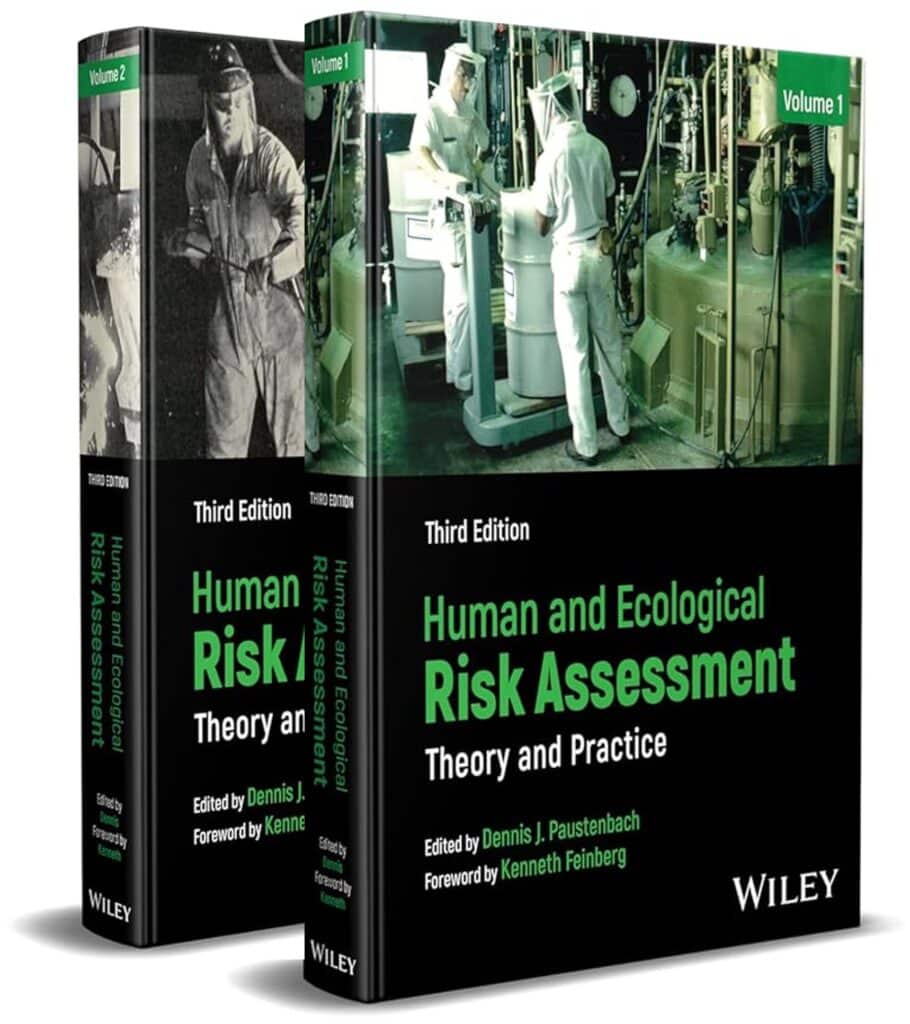
Modern risk assessment evolved from mid-20th century advances in human exposure and toxicology and was formally structured by the U.S. National Academy of Sciences (1983) into a four-step framework that supports environmental regulation, chemical management, and public health decision-making worldwide. The third edition of Dennis J. Paustenbach’s seminal textbook, Human and Ecological Risk Assessment, Theory and Practice, Volumes 1 & 2 (2024, Wiley), covers the fields of chemical fate and transport, ecotoxicology, environmental and exposure science, epidemiology, human toxicology, modeling, pharmacokinetics, and related disciplines that shape modern health and ecological risk assessment practices.
This pair of chapters from Human and Ecological Risk Assessment, Theory and Practice, Volume 2 (3rd edition, Dennis J. Paustenbach, editor; Wiley) reviews current hazard-identification practices that support risk assessment. In the field of risk assessment, hazard identification is the first step and focuses on two key questions: whether a chemical or material could pose a threat to humans or the environment, and if so, what effects might occur after exposure under specific conditions. The answers to these questions depend on evaluating chemical and physical properties, environmental behavior, animal bioassay results, and human epidemiology studies. Historically, hazard identification focused on determining whether a chemical was of negligible or significant importance, often leading to conclusions about the need for further research. However, in the 21st century, this process has significantly evolved, with more nuanced biological responses raising concerns not seen decades ago. The understanding of how chemicals behave and persist in the environment has also improved greatly. New approaches in this initial stage of risk assessment help establish causal links between exposure and adverse effects, as well as the strength of the evidence for causation in humans and ecological receptors. As a result, hazard identification has entered a new era in which its importance continues to grow.
