
Richard J. Wenning – Wenning Environmental LLC, Yarmouth, Maine, US
Theodore D. Tomasi – Integral Consulting Inc, Mooretown, New Jersey, US
Presented at the 35th Society of Environmental Toxicology and Chemistry Europe Meeting, Vienna, Austria, May 2025
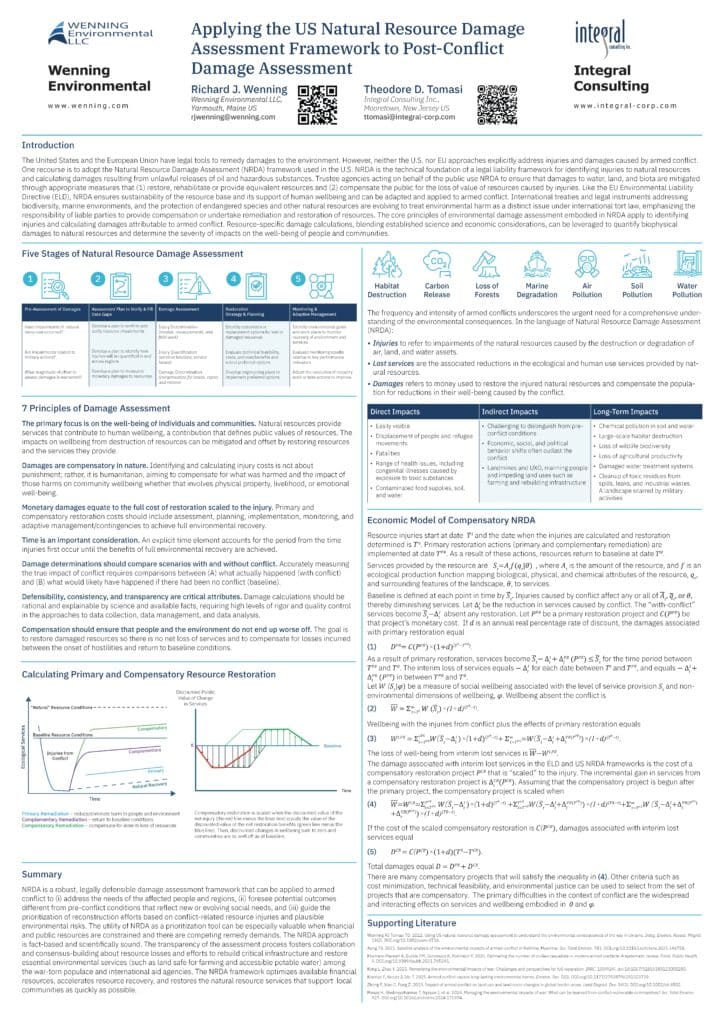 The United States (US) and the European Union (EU) have legal tools to remedy environmental damage, but neither approach explicitly addresses injuries and damages caused by armed conflict. In this presentation from the 2025 SETAC-Europe annual meeting, Wenning & Tomasi recommend adopting the US Natural Resource Damage Assessment (NRDA) framework, with some adjustments. The core principles of environmental damage assessment, embodied in NRDA, apply to the identification of injuries and the calculation of damages attributable to armed conflict. Resource-specific damage calculations, blending established science with economic considerations, can quantify biophysical damage to natural resources and assess the severity of conflict-related impacts on people’s and communities’ well-being.
NRDA merges ecology, economics, and environmental science to support the technical foundation of a legal liability framework that identifies injuries to natural resources and quantifies the damages resulting from unlawful releases of chemicals and materials into the environment. Trustees of a region’s or nation’s natural resources work on behalf of the public to ensure that damages to groundwater, soil, surface water, and wildlife are addressed through (1) restoring, rehabilitating, or replacing with equivalent resources and (2) compensating the public for the temporary and/or permanent loss of these resources.
International treaties and legal instruments addressing biodiversity, marine environments, and the protection of endangered species and other natural resources are evolving to treat environmental harm as a distinct issue under international tort law, emphasizing the responsibility of liable parties to provide compensation or undertake remediation and restoration of resources. NRDA fits this paradigm by (i) addressing the needs of the affected people and regions, (ii) comparing post-conflict conditions to pre-conflict conditions, and (iii) informing strategies for the prioritization of reconstruction efforts. The utility of NRDA as a prioritization tool is especially valuable when financial and public resources are constrained and competing remedy demands arise. The NRDA approach is fact-based and scientifically sound. The transparency of the assessment process fosters collaboration and consensus-building about resource losses and efforts to rebuild critical infrastructure and restore essential environmental services (such as land safe for farming and accessible potable water). The NRDA framework optimizes available financial resources, accelerates resource recovery, and restores the natural resource services that support local communities as quickly as possible.
